
Improving the brand awareness
for a high-tech manufacturing company
I created a business solution that stimulates innovation and enhances the brand awareness for a Dutch high-tech manufacturing company. I did research, observing and context analysis. I interviewed people at the campus, identified key stakeholders and did benchmarking. I created a prototype and tested it. I delivered an advisory memo with the process, insights and concept details. This concept received praising feedback from the CEO’s.

Project details
Brainport Industries Campus
5 weeks
Me and Johanna S.
Experience Designer
Hybrid

Practices
Methods & Tools
Branding, Design Thinking, Service Design,
Experience Design, Concept Design
Context Analysis, Observing, Benchmarking, Interviews, Personas, Value Proposition Canvas, User Journey Mapping, Stakeholder Mapping, Customer Journey Mapping, Prototyping, Testing
Background
Brainport Industries Campus (BIC) in Eindhoven is a smart manufacturing company combining education, innovation, and production. It’s the global hotspot of the industry; they bring together the talent, equipment, and companies of the future, in the factory of the future. They want to have an inspiring climate for open innovation and show off what the high-tech industry is.
The objective of this project was to work in pairs in a chosen opportunity space and create a business solution and hospitality experience that stimulates innovation at the campus and turns it into a place of “wow”. We focused on the people-perspective and brought our expertise in the hospitality industry to the high-tech campus.
Quick Navigation
Building the understanding
We started the project by researching innovations and the company, building our background knowledge to make sure we were asking the right questions when meeting the CEO’s Blankendaal and Veurin. Then we visited the campus and had two presentations from them about the company, asked some further questions, and walked around observing the campus to identify problem areas. After gathering the observations, we identified five opportunity spaces, from which me and Johanna chose the brand awareness.
Brand awareness was an opportunity space because when visiting the campus, expectations didn’t match the reality. Blankendaal and Veurin told us BIC aims to be the industry hotspot, a wow campus, show the world what high-tech industry is, and make people want to be part of it. To make this happen, the brand must be visible inside and outside the campus, and based on our observations, this needed improvement.
We started developing an understanding about the customer’s needs. First we created a quick draft about the company as a customer persona, to get a basic understanding of the potential personality, goals, motivations, and frustrations of the customers.

After gaining an understanding of our brand persona, we created Value Proposition Canvases to help us understand what Brainport Industries Campus (BIC) stands for, what it has to offer, how it answers to customer needs, and what is their value proposition. First, me and Johanna created a canvas from the perspective of BIC in general, and then Johanna created one from the perspective of a startup company located at the campus.


Then we created a User Journey Map to help us identify the journey of an example customer through touchpoints; the thoughts, emotions, pains, and gains. We used a student of Fontys University of Applied Sciences as the example customer. Based on these insights we created the questions for the next campus visit, where we interviewed people. It also helped us to start ideating on our concepts and solutions to answer to the customer needs.


Next, we took a day where we interviewed over 20 people at the campus, from which five of them we got most in depth with. We confirmed that the brand truly wasn’t as visible and clear as desired and multiple issues existed relating to brand awareness.
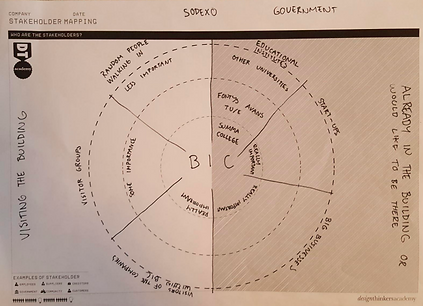
After the interviews Johanna made us a Stakeholder Map, which helped us to better understand which current and potential stakeholders of BIC are relevant to our concept and their level of importance. We learned which ones were the most important stakeholders.
Then it was time for some research. Johanna benchmarked companies and I focused on researching and gaining deeper understanding on customer experience, customer engagement, customer value. After this, we combined our knowledge and insights for concept creation.
Developing the solution
Based on all of our insights until now, it was time to make decisions about what solution we would start developing a concept for. We were inspired by the idea of an experience center and decided to focus on that.

The first impression is important and visiting the campus should be memorable. Based on interviews, we imagined how visitors arrive for meetings at the campus early and have spare time. They are told how BIC is the high-tech industry hotspot and a perfect workspace for their company but based on what they see, it’s hard to believe and imagine the benefits. This is why we wanted our concept to focus on improving the pre-experience and welcoming the visitors.
BIC is said to be the factory of the future, bringing together talent, equipment, and companies of the future. Based on our research and observations, the brand image was not understood or visible enough. There was a need for a one-stop place to experience the BIC picture.
Our concept takes the brand awareness and guest experience to the next level with an interactive experience center. It offers an opportunity to experience the innovations and expertise of BIC in one room within the campus. It represents the brand by showcasing high-tech solutions, uses storytelling to explain the rise of smart industry in Eindhoven and Brainport Industries Campus, and creates interaction between experts and clients. Visitors are able to experience all that BIC has to offer in one space, companies are able to reinforce their brand and market their products, start-ups can pitch their ideas, get visibility, partners and sponsors.
Why an experience center?
For testing our ideas, I prototyped our concept by creating a mock website and a teaser video. We tested it in two ways. Firstly, we went into Breda city center together and talked to people, showing the video and asking short questions about what they thought, reaching 11 people. Secondly, I sent the full prototype to four people with more in-depth questions. Our concept was received very positively, convincing us there is a need for it. One of the respondents said that the concept would help engage and connect with the brand, and people described it as stimulating, educational, and engaging, and were generally interested in learning more and experiencing it in person.


While finalizing the concept, we worked on our pitch using a 10-step model. It helped us to define the problems we were answering to and how we came to find the problems, what solutions to offer, who we are targeting, how we add value to BIC, what other possible solutions there are, who the users are and where they’re from, and what resources are needed to make it all happen.
When we received information that BIC is currently working on a similar idea as ours, we were convinced that implementing our concept and adjusting it to their current plan would achieve great results. We may not be tech professionals, but we do know how to get a story across to people. Our background in hospitality and marketing gave us a thorough understanding of the guest experience and creating brand awareness. The brand can be shared with people experiencing it - all the visitors can become ambassadors of BIC, sharing their stories.

For the target market we focused on 4 groups which we identified with stakeholder mapping: visitor groups, company clients, potential future tenants, and other visitors. We created an example customer journey for how the experience center would ideally affect the customer journey. We created the journey for an owner of a future tenant company, Rick Lamberg. There we laid out the different aspects of the customer journey; the context, journey stages, touchpoints, thoughts and emotions, and opportunity areas.
Final outcome
We developed an experience center with three innovative solutions. Brainport Industries Campus (BIC) is growing and taking visitors through all the buildings and different workspaces will not be possible in the future. The experience center showcases BIC in one room, making the high-tech and innovation clear and visible. We advised where the center should be placed, estimated how it should be scaled in the future, justified the value of the investment making it happen, gave recommendations for collaborating with different stakeholders, how it should all be implemented, and how much staff it requires to run it smoothly throughout the year. For further questions and information, Johanna gathered our findings and created a FAQ which we handed to the CEO's during our pitch. In the end we delivered whitepapers for the CEO’s, with detailed process descriptions and insights for the concept.
We received praising feedback for our concept from both CEO’s after pitching our concept for them.
See my other customer cases


